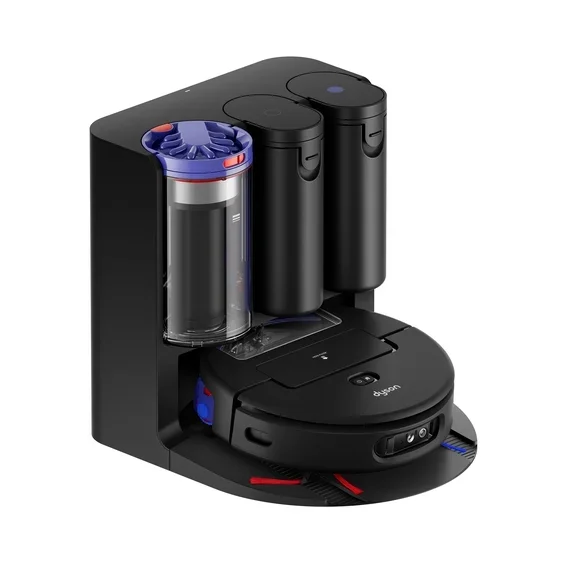
Dyson's roller mop is the more advanced mopping hardware on paper, and its larger onboard water tank keeps that roller fed during long runs, making it a strong pick for homes that are mostly hard floors. The Mova MOBIUS 60 counters with far more suction, a dual brushroll, an extendable side brush, and a dock that washes and dries mop pads at much higher temperatures. Buyers who want the deeper feature list and stronger pickup on mixed flooring should go with the Mova; those drawn to Dyson's mopping approach and dual side brushes will be happy with the Spot+Scrub Ai.
One of these robots leans on a roller mop, the newest approach to robot mopping, and the other stacks nearly every automation feature a dock can hold. That's the real decision here. The Dyson Spot+Scrub Ai brings 18,000 Pa of suction, two side brushes, and a generously sized onboard water tank that feeds its roller. The Mova MOBIUS 60 answers with 30,000 Pa, dual brushrolls, dual spinning mop pads pressed down at 12 N, and a dock that runs at 212 °F for both washing and drying. Both handle multi-level maps and no-go zones. The gap shows up in how much work each one takes off your plate.
Dyson Spot+Scrub Ai
out of 10Mova MOBIUS 60
The widest gap sits in features, 6.5 versus 9.6, and that's what pulls the overall rating apart: 7.5 versus 8.4. Mova's list of extras (mop switching, automatic mop pad removal, dock self-cleaning, extendable side brush, adjustable moisture) simply runs longer. Cleaning lands at 7.8 versus 8.6, which tracks with the suction and brush differences. Navigation is closer, 7.2 versus 7.7, and both are rated as fairly priced for what they deliver.
Suction is the loudest number: 18,000 Pa against 30,000 Pa, and the Mova pairs that with dual rubber-and-bristle brushrolls instead of a single one, which helps on carpet and with tangled hair. Mopping splits in an interesting way. Dyson uses a roller, the newest mopping design out there, supported by a larger robot water tank and three moisture levels. Mova uses dual spinning pads at 260 RPM with 12 N of downward pressure, adjustable moisture, automatic pad detachment before carpet, and mop switching. The docks differ too: Mova's clean and dirty water tanks are both substantially bigger, and it washes and air-dries pads at 212 °F versus Dyson's 140 °F wash and 113 °F dry. Dyson does run longer per charge at 200 minutes versus 180.
Mova's 30,000 Pa and dual brushroll setup pull ahead of Dyson's 18,000 Pa single brush, especially on carpet and along baseboards where its extendable side brush swings out to reach corners. Dyson counters with two side brushes instead of one, which helps sweep debris toward the center on open hard floors.
Dyson's roller mop is the newest mopping design in the category and its larger onboard water tank keeps the roller consistently wet through long runs. Mova's dual spinning pads scrub at 260 RPM with 12 N of pressure, add adjustable moisture, lift 10.5 mm over carpet, detach automatically before vacuuming, and get washed and dried at 212 °F, which adds up to the more complete mopping package.
For a shedding golden retriever, Mova's 30,000 Pa combined with dual brushrolls grabs embedded hair from rugs more reliably than 18,000 Pa and a single brush. Dust bag capacity is close, 3 L versus 3.2 L, so both go weeks between bag changes.
Both use LiDAR plus a camera and both handle no-go zones and multi-level maps, so they map homes accurately. Mova layers AI and 3D structured light onto its camera and LED system and clears obstacles up to 80 mm, so it steps over thicker thresholds and cords, and Dyson's three-level map support with camera plus LED avoidance keeps it competitive across a townhouse.
Mova's dock holds notably more clean and dirty water, so it runs more sessions before you touch it, and it washes and air-dries pads at 212 °F versus Dyson's 140 °F wash and 113 °F dry, which keeps pads fresher between runs. Mova also self-cleans its own dock tray.
Dyson actually runs longer on a single charge at 200 minutes versus 180 for the Mova, despite the Mova carrying the bigger 6,400 mAh battery against 4,900 mAh. Both return to the dock and resume, so either covers a large single floor in one session.
Voice control works on both, with Dyson covering Amazon, Google, and Apple while Mova covers Amazon, Google, and adds built-in voice commands you can give the robot directly. Beyond voice, both offer no-go zones, multi-level maps, smart carpet cleaning, and smart obstacle avoidance, so app-side control feels similar.
| Feature | Dyson Spot+Scrub Ai | Mova MOBIUS 60 |
|---|---|---|
| Suction Power | 18,000 Pa | 30,000 Pa |
| Main Brush Type | Single (rubber & bristle) | Dual (rubber & bristle) |
| Mop Type | Roller | Dual spinning mop pads |
| Battery Life | 4,900 mAh | 6,400 mAh |
| Extendable Side Brush | No | Yes |
| Mop Moisture Levels | 3 | Adjustable |
We may earn a commission if you make a purchase
Both of these clean well and both keep their mops maintained without daily fuss. The Mova MOBIUS 60 is the more capable machine across carpet, edges, and dock automation. The Dyson Spot+Scrub Ai costs less, runs longer per charge, and its roller mop suits hard-floor homes nicely.