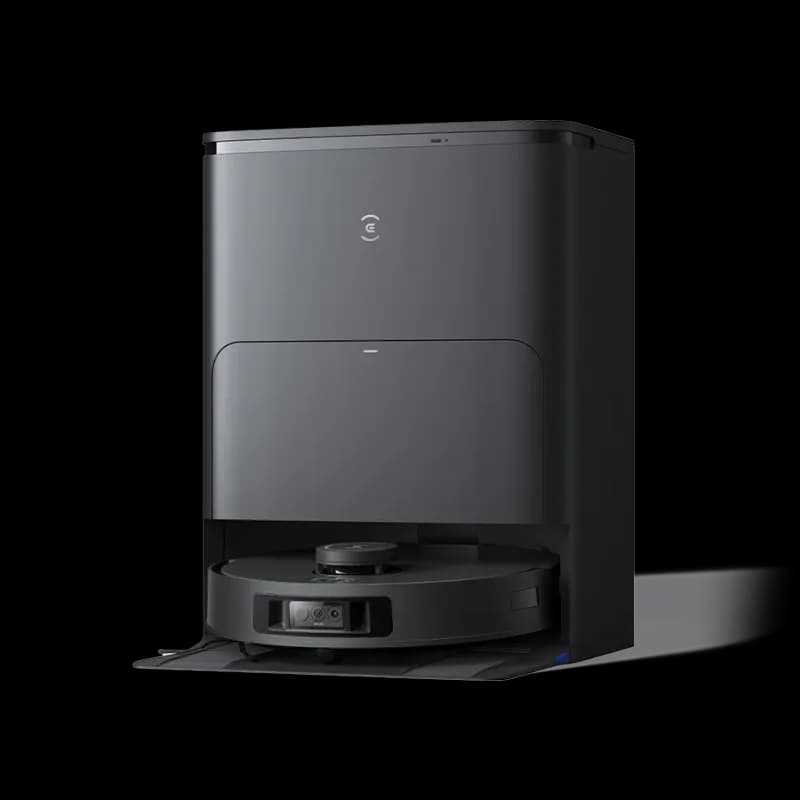
Both of these Ecovacs models run dual spinning mop pads, LiDAR mapping, and 3D structured light obstacle avoidance, so the decision comes down to what happens at the dock and how much you want to spend. The T30S adds hot water mop washing at 158°F, dock self-cleaning, built-in voice control, and slightly stronger 11,000 Pa suction. The N30 Omni counters with automatic detergent dispensing for cleaner mop pads, a longer 320-minute run time, a bigger onboard dustbin, and a noticeably lower price.
Same brand, same core hardware, different priorities. The DEEBOT N30 Omni and DEEBOT T30S both use LiDAR to map your home, both scrub with dual spinning mop pads, and both come with a dock that empties the dustbin and washes the mop. So the interesting stuff sits at the edges: how hot the dock washes the pads, whether detergent gets added to the wash water, how long the robot lasts on a charge, and how much each one costs. This is a comparison about small advantages stacking up rather than one model outclassing the other.
Ecovacs DEEBOT N30 Omni
out of 10Ecovacs DEEBOT T30S
These two rate about as close as it gets: 7.3 overall for the T30S versus 7.2 for the N30 Omni. The N30 Omni pulls ahead on cleaning with a 7.5 rating against 7.2, so it does a bit better on ground-in dirt and general pickup. The T30S answers with a 7.8 navigation rating against 7.0, meaning smarter mapping and fewer stuck moments in cluttered rooms, plus a slight edge on features at 6.4 to 6.1. Both are priced about right, so pick based on whether cleaning power or smarter movement matters more in your home.
Start with the dock, because that's where these two actually diverge. The T30S washes its mop pads with 158°F water and cleans its own washtray afterward, then dries the pads at 113°F. The N30 Omni skips hot washing but automatically doses detergent into the wash, so pads come out cleaner than a plain water rinse. Suction favors the T30S at 11,000 Pa against 10,000 Pa, though the N30 Omni carries a bigger 350 mL dustbin versus 275 mL and runs 320 minutes per charge instead of 290. The T30S also holds more water in the dock, packs a bigger dust bag, and adds built-in voice commands alongside Alexa and Google. And the N30 Omni costs around 25% less.
The T30S pulls 11,000 Pa against the N30 Omni's 10,000 Pa, a gap you'd struggle to feel on most floors, and both use the same single rubber-and-bristle brush. The N30 Omni's 350 mL dustbin holds more than the T30S's 275 mL, meaning fewer trips back to the dock during a big run.
Both scrub with dual spinning mop pads, the strongest widely available mopping setup short of roller systems, with the N30 Omni spinning slightly faster at 200 RPM versus 180 RPM. The T30S takes the group on dock support: 158°F hot water washing and 113°F drying keep pads fresher between runs than the N30 Omni's cool wash and 104°F dry.
For homes with a shedding dog or two cats, the T30S has the edge with 11,000 Pa of suction and a 3 L dust bag in the dock versus the N30 Omni's 2.6 L, so you empty the bag less often. Both use the same brush design, so hair tangle behavior is comparable.
Hardware is identical here: LiDAR for mapping plus 3D structured light for spotting socks, cables, and chair legs on the fly. In practice the T30S maps and routes more reliably, which is why it rates higher for navigation despite the matching sensor list.
The T30S dock holds more clean and dirty water, takes a larger dust bag, washes pads with hot water, and cleans its own washtray. The N30 Omni answers with automatic detergent dispensing, which adds cleaning solution to every mop wash instead of using water alone.
The N30 Omni runs 320 minutes on a charge against 290 minutes for the T30S. On a large single-level home that extra half hour can be the difference between finishing in one pass and pausing for a recharge.
Both handle Alexa and Google voice commands, no-go zones, multi-level maps, smart carpet cleaning, and smart obstacle avoidance. The T30S adds built-in voice control, so you can talk to the robot directly without going through a smart speaker.
| Feature | Ecovacs DEEBOT N30 Omni | Ecovacs DEEBOT T30S |
|---|---|---|
| Auto Detergent Dispensing | Yes | No |
| Dock Self-Cleaning | No | Yes |
| Mop Auto-Washing Temperature | 0 °F | 158 °F |
| Smart Obstacle Avoidance Technology | 3D structured light | 3D structured light |
| Voice Control Platforms | Amazon, Google | Built-In, Amazon, Google |
| Suction Power | 10,000 Pa | 11,000 Pa |
We may earn a commission if you make a purchase
Neither of these disappoints, and they share the parts that matter most: LiDAR, dual spinning mops, and a dock that empties and washes for you. Pick the T30S for the hot water mop care and steadier navigation. Pick the N30 Omni to save real money while keeping longer runtime and detergent-assisted mop washing.