If you're considering a robot vacuum but have carpeted floors throughout your home, you've probably wondered: do robot vacuums actually work on carpet? The short answer is yes, but with important caveats. While modern robot vacuums have made significant strides in carpet cleaning capabilities, their effectiveness varies dramatically based on the specific model you choose and the type of carpeting in your home.

Unlike hard floors where debris sits on the surface, carpet presents unique challenges. Dirt, pet hair, and dust settle deep into carpet fibers, requiring strong suction and specialized brush systems to extract effectively. Some robot vacuums excel on carpet, while others struggle to pick up even surface debris from medium-pile rugs.
In this comprehensive guide, we'll explore exactly how robot vacuums perform on different carpet types, what features matter most for carpet cleaning, and how to optimize your robot's performance. We'll also address common challenges and help you understand when a robot vacuum might not be enough for your carpet cleaning needs.
The relationship between robot vacuums and carpet isn't one-size-fits-all. Success depends heavily on understanding how your specific carpet type interacts with robot vacuum technology. Carpet pile height, fiber density, and weave pattern all play crucial roles in determining cleaning effectiveness.
Most robot vacuums use a combination of suction and rotating brushes to lift debris from carpet fibers. However, the physics change dramatically as carpet gets thicker or denser. What works beautifully on a thin office carpet might fail completely on a plush bedroom rug.
Robot vacuums typically excel on low-pile and medium-pile carpets, which include most standard residential carpeting with pile heights under 0.5 inches. This category encompasses popular styles like berber, loop pile, and cut pile carpets commonly found in living rooms, bedrooms, and hallways.
On these carpet types, quality robot vacuums can achieve cleaning results comparable to traditional upright vacuums for daily maintenance. The shorter fibers allow the robot's brushes to make effective contact with the carpet base, while the suction system can penetrate deeply enough to extract embedded dirt and debris.
Berber carpets, with their distinctive looped construction, present a sweet spot for robot vacuums. The tight weave prevents the brushes from getting tangled, while the moderate pile height allows for excellent debris extraction. Many users report that their robot vacuums actually perform better on berber than on some hard floors, as the carpet texture helps trap debris for pickup.
Cut pile carpets in the low-to-medium range also respond well to robot cleaning. The individual fiber strands stand upright, creating channels that guide debris toward the vacuum's suction path. However, you'll want to ensure your chosen robot has strong enough suction to overcome the fiber resistance.
High-pile and plush carpets over 0.5 inches thick present the biggest challenge for robot vacuums. These luxurious carpet types, including shag rugs and deep plush carpeting, can overwhelm many robot models with their thick, dense fibers.
The primary issue isn't just suction power - it's physics. As pile height increases, several problems emerge: the robot's wheels may sink into the carpet, reducing mobility; the cleaning head may struggle to maintain proper contact with the carpet base; and the dense fibers can clog brushes or prevent them from rotating effectively.
However, don't write off robot vacuums entirely if you have high-pile carpet. Premium models with powerful motors and advanced brush systems can handle moderately thick carpets quite well. Look for robots specifically rated for high-pile carpet, typically those with very high suction power and specialized brush designs.
Some medium and high-end robot vacuums also feature adaptive suction that automatically increases power when carpet is detected. This technology helps overcome the additional resistance of thick fibers, though it does impact battery life. For homes with extensive high-pile carpeting, you might need to run cleaning cycles more frequently or consider supplemental deep cleaning with a traditional vacuum.
One of the trickiest aspects of robot vacuum carpet cleaning involves area rugs and surface transitions. Many robots struggle with the edges of area rugs, either getting stuck on the raised border or failing to climb onto the rug surface entirely.
Modern robot vacuums have improved significantly in this area, with most quality models capable of climbing transitions up to 0.75 inches high. However, performance varies based on the rug's edge design and the robot's approach angle. Rugs with gradual, tapered edges pose fewer problems than those with abrupt, thick borders.
The transition from hard floors to carpet also affects cleaning patterns. Some robots detect the surface change and automatically adjust suction power, while others maintain consistent settings regardless of surface type. This can lead to over-cleaning on hard floors or under-cleaning on carpet sections.
For homes with multiple area rugs, consider the robot's mapping capabilities as well. Advanced models can learn your rug locations and adjust their cleaning approach accordingly, while basic models may treat each encounter as a new obstacle to navigate.
Not all robot vacuums are created equal when it comes to carpet cleaning. Understanding the technical specifications that directly impact carpet performance will help you choose a model that actually works for your specific needs.
Suction power stands as the most critical factor for effective carpet cleaning. While manufacturers often tout impressive-sounding numbers, understanding what these specifications actually mean makes the difference between successful cleaning and disappointment.
Here's the tricky part: the most meaningful measurement would be Air Watts, since it accounts for both airflow and suction strength. But good luck finding that spec on most models. Instead, you'll typically see suction measured in Pascals (Pa), which isn't perfect but at least gives you something to compare. For carpets, you'll want at least 3,000-8,000 Pa – though premium models often push 10,000 Pa or more.
Don't get too hung up on the numbers alone though. Motor efficiency and how the vacuum channels that suction matter just as much. Some robots with moderate suction specs clean carpets beautifully because they've nailed the airflow design and brush roll combination. Others boast huge numbers but can't maintain consistent suction across their cleaning head, especially when transitioning from hard floors to carpet. The best performers balance raw power with smart engineering - getting that suction where it needs to be without losing it through poor seals or inefficient pathways.
Many modern robots also feature variable suction with carpet-specific boost modes. These systems automatically detect carpet surfaces and increase suction power by 50-100%, providing the extra power needed to extract debris from carpet fibers while conserving battery life on hard surfaces.
The brush system determines how effectively a robot vacuum can agitate carpet fibers and lift embedded debris. Different brush designs excel in different scenarios, and understanding these differences helps explain why some robots work better on your specific carpet type.
Traditional bristle brushes remain popular for carpet cleaning due to their aggressive fiber agitation. The stiff bristles penetrate carpet pile and dislodge embedded dirt, working similarly to the brush roll in an upright vacuum. The downside? They're notorious for tangling with pet hair and carpet fibers. That's why many newer bristle brush models now include anti-tangle features (like alternating bristle patterns or self-cleaning mechanisms that help prevent hair wrap). Still, even with these improvements, bristle brushes typically need more maintenance than their rubber counterparts.
Dual rubber roller systems have gained popularity for their inherently tangle-resistant design and surprisingly effective carpet performance. While they might seem less aggressive than bristle brushes, quality rubber rollers can flex and conform to carpet surfaces, creating excellent debris pickup while virtually eliminating hair tangles. Some manufacturers have taken this further with counter-rotating designs, textured patterns, or other mechanisms that actively reject hair wrap while maintaining that crucial carpet agitation.
Hybrid designs are becoming more common too - combining rubber extractors with bristle elements or featuring specialized anti-tangle bristles that are shorter and more widely spaced. These aim to give you the best of both worlds: strong carpet cleaning without the maintenance headaches.
Side brush configuration also impacts carpet performance. Single side brushes work well for directing debris toward the main cleaning head, while dual side brush systems can sometimes scatter lightweight debris on carpet surfaces. Look for models with adjustable side brush speed or carpet-specific side brush settings.
Automatic height adjustment represents one of the most important yet overlooked features for carpet cleaning effectiveness. This technology allows the robot to maintain optimal brush contact across different surface heights, crucial for consistent cleaning performance.
Advanced robots use multiple sensor types to detect surface changes: optical sensors identify carpet texture and color differences, while pressure sensors detect when wheels encounter height changes. The best systems combine these inputs to automatically adjust cleaning head height within milliseconds of surface detection.
Some premium models offer user-adjustable height settings, allowing you to fine-tune performance for specific carpet types. This manual control can be particularly valuable for homes with unusual carpet styles that might confuse automatic sensors.
Cliff sensors also play a role in carpet performance, as overly sensitive settings might cause the robot to avoid area rugs or carpet transitions (like confusing dark colors for a drop/cliff). Look for models with adjustable cliff sensor sensitivity or carpet-specific sensor modes.
Getting the best results from your robot vacuum on carpet requires more than just pressing the start button. Strategic preparation and smart usage patterns can dramatically improve cleaning effectiveness while extending your robot's operational life.
Proper room preparation makes the difference between mediocre and excellent carpet cleaning results. Unlike hard floors where obstacles are immediately obvious, carpet can hide potential problems that derail cleaning cycles.
Of course, start by removing small objects that might get caught in the robot's brushes or wheels. This includes coins, jewelry, and small toys that could cause issues.
Also address carpet-specific hazards like loose edges on area rugs, which can jam the robot's wheels, or electrical cords that might blend with dark carpet colors. Using cord organizers or temporary cord management during cleaning cycles prevents frustrating interruptions.
For high-pile carpets, a quick pre-vacuum with a traditional upright can actually improve robot performance. Removing surface debris allows the robot to focus on embedded dirt rather than becoming overwhelmed by large particles or extensive pet hair.
Carpet responds differently to cleaning frequency than hard floors. While daily cleaning might be excessive for hard surfaces, carpets benefit from more frequent robot vacuum sessions due to their debris-trapping nature.
For most carpet types, every other day cleaning provides optimal results without excessive wear on the robot's components. High-traffic carpeted areas might benefit from daily cleaning, while low-traffic bedrooms could extend to every third day.
Utilize spot cleaning modes for targeted carpet treatment. Most quality robots offer focused cleaning patterns that spend extra time on specific areas, perfect for addressing spills or high-traffic zones that accumulate more debris.
Consider splitting large carpeted areas into separate cleaning zones if your robot supports room division. This approach allows for more thorough cleaning of each section and prevents the robot from becoming fatigued before completing the entire carpeted area.
Time cleaning cycles for optimal carpet performance. Running the robot when carpet fibers are dry and standing upright (like the morning, before much activity has happened for the day) often produces better results than cleaning immediately after foot traffic has compressed the fibers.
Carpet debris places unique demands on robot vacuum maintenance systems. Fine carpet fibers, embedded dirt, and accumulated pet hair require more frequent and thorough maintenance than debris from hard floors.
Clean the main brush system after every 2-3 carpet cleaning cycles, or whenever you notice reduced performance. Carpet fibers and hair wrap around brushes more readily than hard floor debris, and allowing buildup reduces cleaning effectiveness while straining the motor.
Replace filters more frequently when primarily cleaning carpet. The fine particles extracted from carpet fibers can clog filters faster than larger hard floor debris. Plan on filter replacement every 2-3 months for heavy carpet use, compared to 4-6 months for mixed or primarily hard floor cleaning.
Empty the dustbin after each carpet cleaning session if possible. Carpets release more debris volume than hard floors, and a full dustbin reduces suction power significantly. Some advanced models alert you when dustbin capacity affects performance, but proactive emptying ensures consistent results.
Check wheel mechanisms regularly for carpet fiber tangles. While less common than brush tangles, carpet fibers can occasionally wrap around wheel axles, affecting mobility and potentially damaging drive components.
Even the best robot vacuums face specific challenges when cleaning carpet. Understanding these common issues and their solutions helps you troubleshoot problems and optimize performance for your specific carpet types.
High-pile rugs and carpet transitions are one of the most frequent causes of robot vacuum getting stuck. The combination of thick fibers and raised edges can trap even capable robots, but especially older or budget models.
Prevention starts with rug selection and placement. If purchasing new area rugs, consider robot-friendly options with tapered edges and moderate pile heights. For existing rugs that cause problems, rug grippers or double-sided tape can secure edges and create smoother transitions.
Strategic placement can also help avoid problems. Position furniture to create natural barriers that guide the robot around particularly troublesome rug edges, or use virtual walls and no-go zones if your robot supports them.
For unavoidable high-pile rugs, consider scheduled exclusion zones during regular cleaning cycles, with periodic manual placement of the robot directly onto the rug for targeted cleaning. This approach provides rug cleaning without risking stuck situations during whole-home cycles.
Some users successfully modify problematic rugs by trimming excess pile height around edges or adding transition strips. While this requires careful work, it can transform an unusable rug into one your robot handles easily.
Pet hair represents one of the biggest challenges for robot vacuum carpet cleaning. Unlike hard floors where hair remains on the surface, carpet fibers trap pet hair deep within the pile, requiring aggressive agitation and strong suction for removal.
Pet households should increase cleaning frequency significantly. Daily robot vacuum sessions help prevent hair accumulation that becomes increasingly difficult to remove. You could even consider running cycles twice daily during heavy shedding seasons.
You can also pre-treat heavily affected areas with a rubber squeegee or pet hair removal tool before robot cleaning. This manual pre-treatment lifts embedded hair to the surface where the robot can more easily capture it.
If pet hair is a primary concern, you can choose robot models specifically engineered to handle it. Look for features like anti-tangle brush systems, extra-strong suction modes, and specialized pet hair detection that automatically increases agitation or suction in affected areas.
For deep debris removal, combine robot vacuum cleaning with periodic traditional vacuum sessions. Robot vacuums excel at daily maintenance, but monthly deep cleaning with a powerful upright ensures embedded debris doesn't accumulate over time.
Most robot vacuum body designs inherently limit edge and corner cleaning effectiveness on carpet. The common round shape that enables smoother navigation also creates gaps along walls and in corners where debris can accumulate. Many mid-range and premium vacuums have started to include extendable side brushes to account for this. They are able to reach out into edges and corners to better collect debris.
You can maximize side brush effectiveness by keeping carpet edges clear of obstacles that might deflect the brush or prevent proper contact. Furniture placement that allows the robot to approach edges straight-on improves cleaning coverage compared to angled approaches.
It's also recommended to periodically do a manual edge cleaning to supplement robot performance. A handheld vacuum or traditional upright can address corner accumulation that the robot cannot reach, maintaining overall carpet cleanliness.
Consider carpet edge design when replacing flooring. Carpets that terminate flush against walls or transition smoothly to baseboards provide better robot access than those with raised edges or complex trim work.
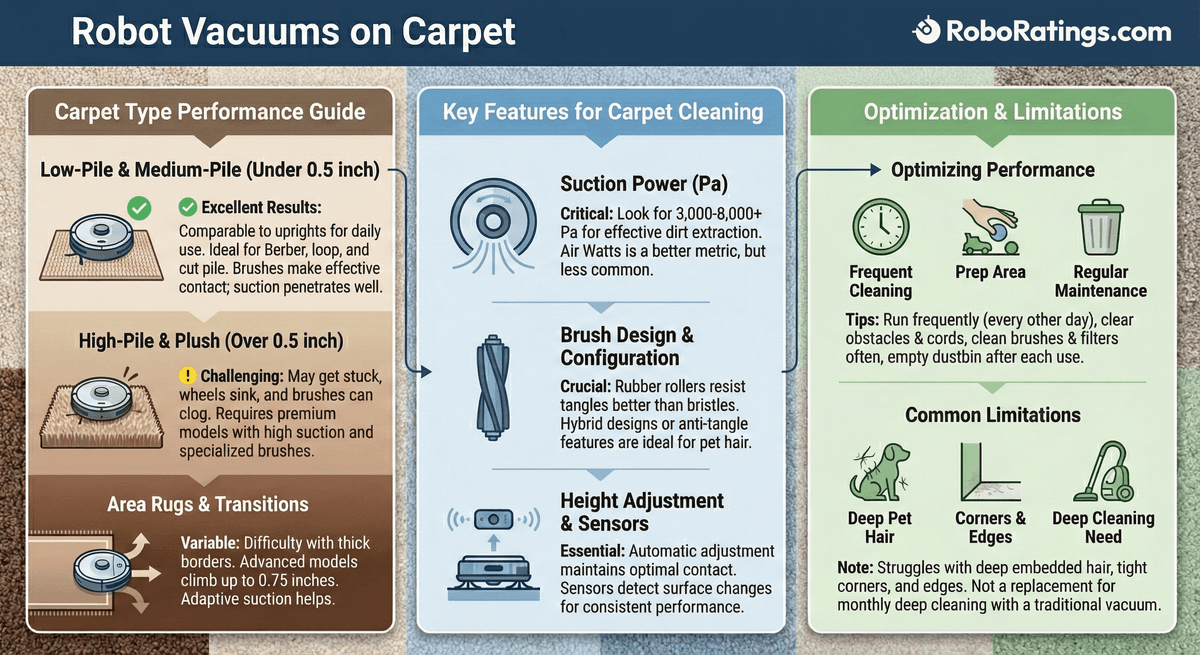
An honest assessment reveals that robot vacuums, despite impressive technological advances, cannot completely replace traditional carpet cleaning methods in all situations. Understanding these limitations helps set realistic expectations and develop effective cleaning strategies.
Robot vacuums excel at daily maintenance cleaning but lack the intensive agitation and suction power needed for deep carpet cleaning. The lightweight design that enables autonomous operation also limits the mechanical force available for embedded debris extraction.
Plan for monthly deep cleaning sessions with a traditional upright or canister vacuum, regardless of robot vacuum quality. This supplemental cleaning addresses debris that gradually accumulates below the robot's effective cleaning depth, maintaining long-term carpet health and appearance.
Certain carpet styles and constructions present challenges that even premium robot vacuums struggle to overcome effectively. Recognizing these problematic carpet types helps inform purchasing decisions and cleaning expectations.
Frieze or twist carpets with extremely kinked fibers can trap robot brushes and reduce cleaning effectiveness. The twisted fiber construction that provides durability and stain resistance also creates microscopic pockets where debris can hide from robot cleaning action.
Loop pile carpets with loose or uneven loops pose tangling risks for robot brushes. While many robots handle standard berber-style loop carpets well, irregular or artisanal loop constructions can snag brushes or cause navigation problems.
Natural fiber carpets like wool or jute require gentler cleaning approaches that may not align with robot vacuum capabilities. These materials can be damaged by aggressive brush action or may release fibers that clog robot systems more readily than synthetic carpets.
Antique or delicate carpets should generally be excluded from robot vacuum cleaning routines. The mechanical stress of regular robot cleaning, while minimal, can accelerate wear on valuable or fragile carpet constructions that require specialized care.
Robot vacuums can indeed work effectively on carpet, but success depends heavily on choosing the right model for your specific carpet types and understanding the technology's capabilities and limitations. Low-pile and medium-pile carpets respond excellently to robot vacuum cleaning, often achieving results comparable to traditional vacuums for daily maintenance.
The key lies in matching robot capabilities to your carpet characteristics. Features like strong suction power, effective brush systems, and automatic height adjustment make the difference between satisfactory and excellent carpet performance. Premium models with carpet-specific features justify their higher costs through superior cleaning results and reliability.
However, robot vacuums work best as part of a comprehensive carpet care strategy rather than a complete replacement for traditional cleaning methods. Regular robot maintenance cleaning combined with periodic manual deep cleaning provides optimal carpet care while maximizing convenience.
For most homeowners with standard residential carpeting, a quality robot vacuum can handle 80% of carpet cleaning needs while providing the convenience of automated daily maintenance. Understanding your specific carpet types, choosing an appropriately capable robot, and optimizing setup and maintenance practices will help you achieve the best possible results.
