Picture this: your old robot vacuum bumps into your coffee table for the fifth time, then spends ten minutes trying to escape from under your couch. Meanwhile, your neighbor's robot vacuum glides smoothly around furniture, methodically cleans each room, and returns to its dock without breaking a sweat. The difference? LiDAR navigation.
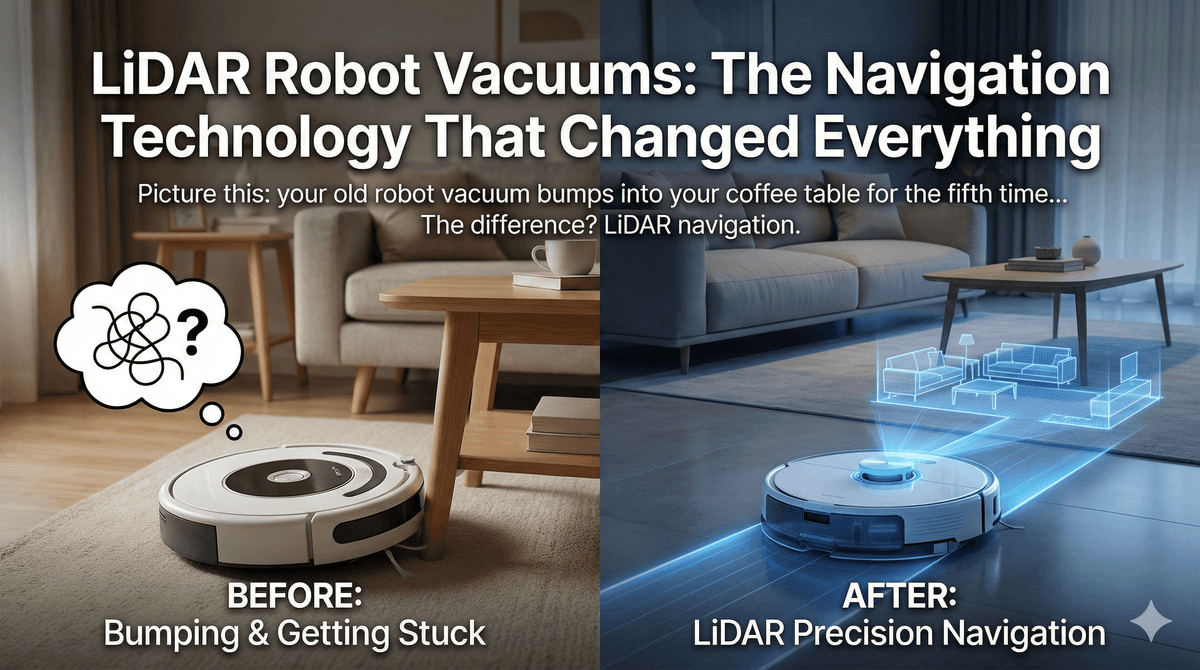
LiDAR technology has become the gold standard for robot vacuum navigation, transforming these devices from random wandering bumper cars into precision cleaning machines. If you're wondering what all the LiDAR hype is about, you're in the right place.
Here's what we'll cover: how LiDAR actually works (without the technical jargon), why it's such a game-changer for cleaning performance, and whether you really need it in your home. Spoiler alert: for most people, the answer is probably yes.
LiDAR stands for "Light Detection and Ranging," but don't let the fancy name intimidate you. Think of it as your robot vacuum's way of "seeing" your home using invisible laser light. Instead of bumping around randomly like early Roombas, LiDAR-equipped vacuums create detailed maps of your rooms and navigate with surgical precision.
The technology isn't new - it's the same system that helps self-driving cars avoid accidents and enables archaeologists to discover hidden ruins beneath jungle canopies. But when applied to robot vacuums, it's absolutely revolutionary.
Here's why LiDAR matters: traditional robot vacuums clean your floors about as efficiently as a toddler with a toy car. They bump into things, get stuck, and miss entire sections of your home. LiDAR vacuums, on the other hand, know exactly where they are, where they've been, and where they need to go next.
Don't worry - I'm not about to launch into a physics lecture. But understanding the basics helps explain why LiDAR vacuums perform so much better.
The LiDAR sensor (that spinning tower on top of many robot vacuums) continuously emits invisible laser pulses in all directions. When these lasers hit objects - your walls, furniture, or that pile of shoes by the door - they bounce back to the sensor. By measuring how long it takes for each laser pulse to return, the vacuum calculates the exact distance to every object around it.
This happens incredibly fast - we're talking thousands of measurements per second. The vacuum's computer processes all this distance data to build a real-time map of your room. It's like having a surveyor constantly measuring your home while your vacuum cleans.
The really clever part? Your vacuum remembers this map. After the first cleaning session, it knows your home's layout and can plan the most efficient cleaning route every time. No more random wandering or repeatedly cleaning the same spot while ignoring others.
Let's be honest about the alternatives, because not all robot vacuum navigation is created equal.
Here's where LiDAR technology really shines in real-world use.
The first time your LiDAR vacuum runs, it's essentially surveying your home like a professional mapper. It identifies walls, doorways, furniture placement, and creates a detailed floor plan that's often more accurate than what you could sketch by hand.
But here's the kicker - it remembers everything. Your vacuum stores this map and uses it for every future cleaning session. If you move a chair, it notices and updates the map. If you close a bedroom door, it knows not to try accessing that room.
This is where you really see the difference in daily use. Traditional robot vacuums clean like they're playing pinball - bouncing around randomly until they've (hopefully) covered everything. A LiDAR vacuum plans its route like a professional house cleaner.
Most LiDAR vacuums use systematic patterns, typically cleaning in straight lines with slight overlaps to ensure complete coverage. They'll finish one room completely before moving to the next, rather than wandering back and forth between areas.
The time savings are significant. Where a random-navigation vacuum might take 90 minutes to clean your main floor (and still miss spots), a LiDAR model typically finishes the same job in 45-60 minutes with better coverage. That's the power of having a plan versus wandering around aimlessly.
Here's where LiDAR technology really pays dividends - it unlocks smart features that simply aren't possible with other navigation systems.
These features transform your robot vacuum from a simple cleaning tool into a genuinely smart home assistant.
Real talk: no technology is perfect in every situation. Let's look at how LiDAR navigation handles various home challenges.
This is where LiDAR absolutely dominates camera-based systems. Since LiDAR uses laser light rather than visible light, darkness is irrelevant. Your vacuum navigates just as precisely at midnight as it does at noon.
This is particularly valuable if you prefer running your vacuum when you're asleep or away from home. Many people schedule cleaning cycles for early morning or while they're at work - times when rooms might be dark or have limited lighting. Camera-based vacuums can struggle or fail completely in these conditions (though built-in lights can help), while LiDAR vacuums perform flawlessly.
LiDAR really shines in homes with challenging layouts. Open floor plans, multiple rooms, and furniture-heavy spaces that would confuse simpler navigation systems are handled with ease.
The technology excels at detecting and avoiding obstacles in real-time. Chair legs and pet toys left on the floor are typically detected and avoided. The vacuum builds these temporary obstacles into its cleaning plan, working around them rather than getting stuck.
However, LiDAR isn't magic. Very low furniture (under 3 inches) can still trap vacuums since the laser can't "see" underneath. And while LiDAR detects obstacles, it doesn't identify them - so your vacuum might avoid a sock on the floor rather than identify and alert you about it.
Here's something people often wonder about: does all this fancy navigation technology actually help with cleaning performance? The answer is yes, but indirectly.
LiDAR doesn't make your vacuum's suction stronger or its brushes more effective. But by ensuring complete, systematic coverage, it guarantees that every area gets cleaned properly. No more finding pet hair tumbleweeds in corners that your vacuum randomly missed.
Let's be honest about where LiDAR technology has limitations. No system is perfect, and understanding these constraints helps you make an informed decision.
The biggest drawback is simple: LiDAR adds cost. For budget-conscious buyers, this premium can be tough to justify - but even budget models are beginning to incorporate LiDAR systems nowadays.
Here's my take: if you can afford it, LiDAR is worth the investment for nearly all homes. The time savings, better cleaning coverage, and advanced features quickly pay for themselves in convenience and performance. It's the difference between owning a cleaning tool and owning a cleaning assistant.
That said, if you have a very simple home layout - like a studio apartment or single-room space - the benefits of LiDAR might not justify the extra cost. Random navigation can work adequately in truly simple environments.
LiDAR isn't foolproof. The technology struggles with certain materials and situations:
Most of these limitations are minor in real-world use, but they're worth understanding before making a purchase decision.
Not all LiDAR implementations are created equal. Here's what to evaluate beyond just having the technology.
The quality of LiDAR sensors varies significantly between models and manufacturers. Higher-end sensors can map larger areas more accurately and update their maps faster when obstacles change.
Check the reviews around mapping accuracy for models you're interested in - some budget LiDAR implementations create rough, blocky maps while premium sensors generate detailed, precise floor plans.
The sensor's rotation speed also matters. Faster-spinning sensors update maps more frequently, leading to better obstacle avoidance and more precise navigation.
LiDAR navigation is only as good as the software that interprets the data. Look for apps that offer:
The best LiDAR vacuums also offer features like saved maps for multiple floors, customizable cleaning preferences for different rooms, and detailed cleaning reports showing exactly where your vacuum went.
Some manufacturers excel at software while others focus purely on hardware. Research the app experience as carefully as you research the vacuum's cleaning performance.
Here's the bottom line: LiDAR navigation represents a genuine leap forward in robot vacuum technology. It transforms these devices from somewhat helpful cleaning tools into genuinely intelligent home assistants.
The benefits are real and immediate - better cleaning coverage, significant time savings, and advanced features that make customization simple. While the technology adds some cost, most users find the investment worthwhile given the dramatic improvement in performance and convenience. The technology is mature, reliable, and continues improving with software updates.
If you're ready to upgrade from random bumping to precise navigation, focus on models with quality LiDAR sensors, robust app features, and good manufacturer support. Your floors, and your sanity, will thank you.
